Judging the Basset Hound: structure, movement, and breed priorities
Correctly judging the Basset Hound requires an understanding of far more than a long body and short legs. While the breed is instantly recognizable, its unique structure, movement, and functional design can challenge judges who are more familiar with longer-legged breeds. This article summarizes key points from Judging the Basset Hound by Richard Nance, offering practical guidance on breed type, balance, movement, and the priorities outlined in the AKC Breed Standard.
For judges, breeders, and exhibitors seeking deeper study, the original illustrated PDF is available for download below.
Download the full PDF: Judging the Basset Hound
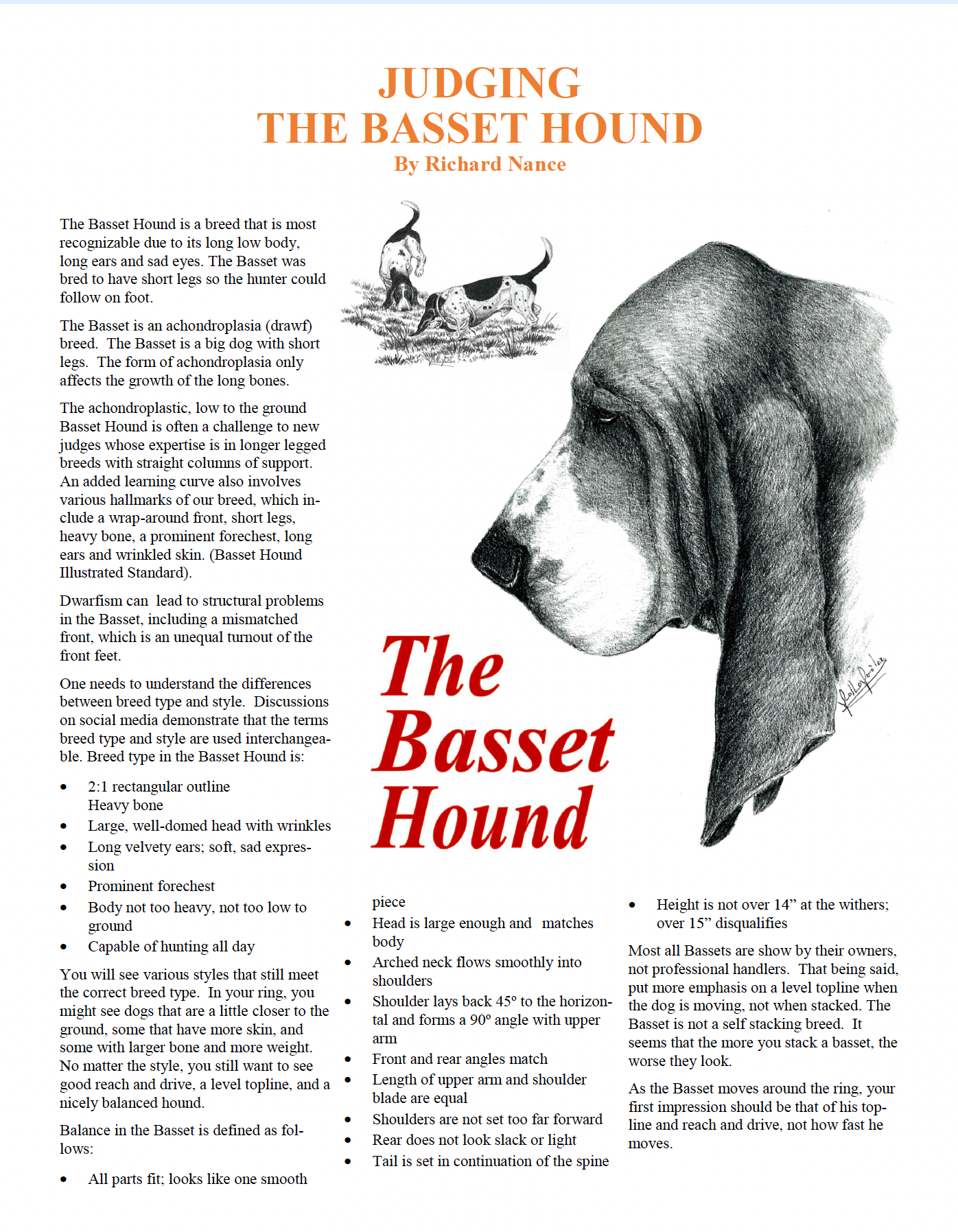
Understanding breed type versus style
One of the most common sources of confusion in the ring is the difference between breed type and style. Breed type refers to the essential characteristics that define a correct Basset Hound, while style reflects individual variation that can still fall within the standard.
Correct breed type in the Basset Hound includes:
-
A 2:1 rectangular outline
-
Heavy bone on short legs
-
A large, well-domed head with loose skin and wrinkles
-
Long, low-set, velvety ears
-
A prominent forechest
-
A body that is substantial without being excessive
-
A hound capable of working all day in the field
Within that framework, dogs may vary in skin, bone, or closeness to the ground. Regardless of style, balance, reach, drive, and sound movement remain essential.
Balance and correct structure
Balance is central to evaluating the Basset Hound. A balanced hound appears as one smooth, unified piece rather than a collection of parts.
Key elements of balance include:
-
A head that matches the body in size and substance
-
A well-arched neck flowing smoothly into the shoulders
-
Proper shoulder layback (approximately 45 degrees) with equal length of shoulder blade and upper arm
-
Matching front and rear angulation
-
A tail set as a natural continuation of the spine
-
Rear structure that is strong and well-let-down, never slack or light
Because the Basset is an achondroplastic breed, judges must understand how dwarfism affects structure, particularly in the front assembly. A correct wrap-around front, heavy bone, and slightly turned-out feet are hallmarks of the breed, not faults.
Judging on the ramp and hands-on evaluation
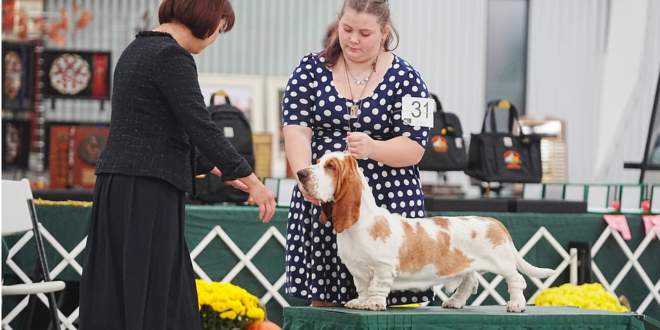
The Basset Hound must be judged on the ramp. Re-examinations should always return to the ramp rather than the ground. Hands-on evaluation is critical for assessing true structure beneath loose skin.
During examination, judges should:
-
Confirm a prominent forechest with real bone, not just skin
-
Check for a scissor or even bite
-
Evaluate shoulder placement and elbow closeness to the ribcage
-
Feel for length of keel and correct rib shape
-
Assess rear structure for parallel movement and stability
Forequarters and hindquarters should appear approximately the same width when viewed from above, reinforcing overall balance.
Movement: a top priority
Movement reveals many of the breed’s most serious faults. A correct Basset Hound moves with a smooth, powerful, deliberate gait that is never clumsy. Speed is irrelevant; coordination and efficiency matter.
Correct movement includes:
-
A level topline while moving
-
Good reach and drive
-
Front legs that do not paddle, weave, or overlap
-
Hind legs that move parallel when going away
-
No single tracking
Many structural problems, especially in the front, can be disguised when stacked but become obvious on the move. For this reason, movement should carry significant weight in final evaluations.
Size, faults, and disqualifications
Judges must remain vigilant about size. Height over 15 inches at the withers is a disqualification, and the wicket should be used when necessary.
The AKC Breed Standard prioritizes faults as follows:
-
Serious faults include steep shoulders, fiddle fronts, elbows out, cowhocks, bowed legs, poorly angulated hindquarters, and incorrect bites
-
Faults include dry heads, flat skulls, very light eyes, flanged ribs, and topline issues
-
Disqualifications include knuckling over, distinctly long coats, and height over 15 inches
Understanding these priorities ensures consistent, breed-correct judging.
Why this guidance matters
Most Basset Hounds are owner-handled rather than shown by professionals. Judges should place greater emphasis on how the dog moves naturally rather than how it appears when heavily stacked. A correct Basset Hound should always look functional, balanced, and capable of doing the job it was bred to perform.
Author credit and source
This article is based on Judging the Basset Hound by Richard Nance, Judge Education Committee Chair. The original work includes detailed illustrations, anatomical references, and expanded guidance for judges.
© Richard Nance. Reproduced with credit for educational purposes.
For the complete illustrated reference, please download the original PDF.