Jump into Agility!
Agility is a fun, fast-paced sport that gives Basset Hounds a chance to show off their athletic ability, confidence, teamwork, and unmistakable Basset charm.
Who may participate in agility?
- Basset Hounds with AKC Registration: Full or Limited, PAL, or Canine Partners
- Your Basset must be at least 15 months of age for safety
- Spayed or neutered Bassets
Who may not participate?
- Bitches may not compete while in season
- Bassets with physical disabilities or active injuries may not compete
Why is Agility a great fit for Basset Hounds?
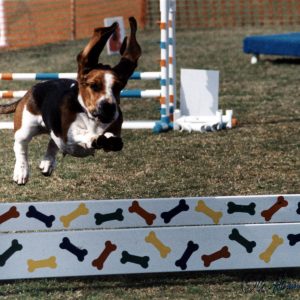
Many Basset Hounds are quite athletic and enjoy spending time with their owners in agility. What could be more fun than seeing ears flying and tails wagging while a Basset completes an agility course? Some other breed handlers may be surprised, but the Basset truly is versatile and often proves just how capable this breed can be.
The purpose of an AKC Agility Trial is to demonstrate a dog’s soundness, physical ability, and willingness to follow the handler’s direction. Agility includes many levels, beginning with basic fundamentals and progressing to more advanced courses with higher degrees of difficulty.
Beyond competition, agility offers a wonderful way to exercise with your dog, build confidence, improve focus, and strengthen the partnership between you and your Basset Hound.
What happens on an agility course?
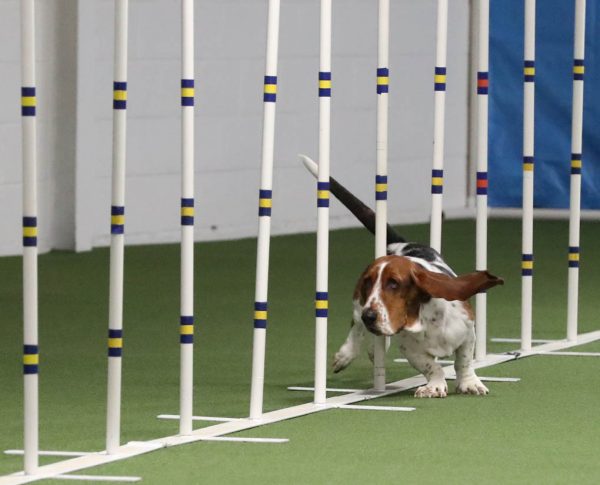
You will direct your Basset Hound through a predetermined obstacle course that may include pause tables, tunnels, seesaws, weave poles, and jumps. Your dog follows your cues to complete the course, making agility a true team sport between dog and handler.
Is agility the right sport for you?
If you have never seen an agility trial, start by watching one. Don’t be intimidated. You can find a class, attend for fun, and see whether you and your Basset enjoy it. If you both have a good time, you may want to consider competing.
Getting Started in Agility
Training
The best way for you and your Basset to learn the sport of agility is to attend classes at a local dog training center. You can search the AKC web site for obedience and agility clubs in your area. These are the organizations that host the trials in which your and your dog may compete. The average dog, training once or twice a week with an experienced agility trainer, will take six months to a year to be ready to compete at an agility trial. It may sound like a long time but you and your Basset will have fun and build a strong bond as you learn to navigate obstacles and work your way through an agility course.
Competition Overview
Agility Course Test (ACT)
One of the best ways to start competing is to use the entry level event called (ACT) which was developed by the American Kennel Club to introduce new exhibitors to the sport of Agility. It will help new handlers learn some of the basics such as:
- fill out an AKC entry form
- check-in at the ring
- handle their dog and run a course while being judged.
The Agility Course Test has two levels: ACT1 and ACT2. Earning a qualifying score in ACT1 requires:
- Run a course at any jump height with 10-12 obstacles
- A-Frame (5’), Table, Jumps, Open tunnels
- Complete the course in 60 seconds
- No missed contacts
- No dropped bars
- No obstacle attempted more than 3 times
- No more than 3 wrong courses
To earn the ACT 1 title you must earn two qualifying scores. After completing ACT1 you and your dog will have demonstrated that you have mastered the fundamentals of agility.
Once you have completed ACT 1 you can compete in ACT2. ACT2 requires that dogs show an increased skill level of training and helps to prepare you and your dog to compete for titles at full AKC agility trials. ACT2 requires you to:
- Run a course at any height, 11-13 obstacles
- A-Frame (5’), Teeter, Dog Walk (allowed), Tire, Table, Jumps, Spread jumps (1), Weave Poles (6), Open tunnels
- Complete the course in 70 seconds
- No missed contacts
- No dropped bars
- No obstacle attempted more than 3 times no more than 3 wrong courses
To earn the ACT 2 title you must receive two qualifying scores at this level.
AKC Agility Trials
Once dog and handler teams demonstrate a higher level of skill they can considering entering formal AKC agility trials. It is helpful but not required that beginners earn ACT titles before trying agility.
There are three types of AKC Agility trials:
- All Breed. Open to all AKC-recognized breeds and in most cases to Canine Partners. This is how most agility trials are run.
- Specialty. Open to a single AKC-recognized breed, such as the Basset Hound only trial held during the BHCA Nationals.
- Group Trials. Open to all AKC-recognized breeds in one of the seven Groups (Sporting, Hound, Working, Terrier, Toy, Non-Sporting, Herding). Basset Hounds are (obviously) part of the Hound Group.
There are several types of classes offered at an agility trial:
Standard Agility is the class that most people have seen on television. It is showcased by the three contact obstacles that are always present: A-frame, dog walk, and seesaw/teeter. Each obstacle has a “contact zone” of a contrasting color (typically yellow) on each side. The Standard Agility class also has jumps, weave poles, open tunnels, and a pause table.
To receive a qualifying score: Your Basset must complete every obstacle on the course in the designated order (some course corrections are allowed) within the allowed time. He/She must place at least one paw in the contact zone on the exiting side of each contact obstacle and not knock down any jump bar or step on the broad jump.
There are five levels of classes within Standard Agility; as the levels increase so does the total number of obstacles, course complexity, and required minimum speed for a qualifying score. Except for the Premier Class, which is open to all dogs, you must successfully complete titles in one level before moving up to the next level. The levels in Standard Agility are:
- Novice Standard A (dog and handler new to agility) and B (experienced dogs and handlers)
- Open Agility Standard
- Excellent Agility Standard
- Master Agility Standard
- Premier Agility Standard (open to all levels but very difficult and complex courses)
Jumpers with Weaves (aka Jumpers or JWW)
In the Jumpers with Weaves (Jumpers) Agility class the skill sets required are jumping, speed, and focus. It consists of only jumps, one set of weave poles, and possibly one or two open tunnels. The course times are faster and dog and handler need to be able to complete the course quickly without knocking down any bars or taking obstacles in the wrong order.
To receive a qualifying score: Your Basset must complete every obstacle on the course in the designated order (no course corrections are allowed) within the allowed time.
As with Standard Agility, Jumpers with Weaves agility has multiple levels of competition. As classes increase the number of obstacles increases as does the complexity of the order of obstacles. The class levels within Jumpers with Weaves are:
- Novice A and B Jumpers With Weaves
- Open Jumpers With Weaves
- Excellent Jumpers With Weaves
- Master Jumpers With Weaves
- Premier Jumpers with Weaves
Fifteen And Send Time (FAST)
The FAST class is a challenging test of distance handling and course strategy. Speed, obstacle skills, and handling accuracy are also important. As suggested by the name, the Fifteen and Send Time class uses fifteen (15) point-valued obstacles and/or obstacle combinations. The course includes a ‘Send Bonus’ or distance element that will award a bonus of twenty (20) points if performed successfully. Depending upon the level, the dog and handler team must accumulate points and successfully complete the Send Bonus before the buzzer sounds the end of the allowed time. Increasing levels require more points and a more difficult Send Bonus.
The FAST classes are:
- Novice A and B FAST
- Open FAST
- Excellent FAST
- Master FAST
The Time 2 Beat (T2B) agility titling class requires the handler/dog to achieve an efficient line with accuracy and speed. The dog that sets the quickest time in each jump height sets the time to beat for that jump height and earns the maximum (10) points for that class; slower times earn fewer points but everyone who earns a qualifying score earns at least one point. Dogs must accumulate 100 points to achieve the T2B title.
Each agility level and class is also available as Preferred. In the Preferred class the dog and handler complete the same course but with jumps set four inches lower than the dog’s normal height. Titles have the letter “P” added to indicate it was earned at the lower height. Most Basset Hounds run in Preferred classes.
Levels of Agility
Novice. For those starting in agility there are 14 to 16 obstacles.
Open. For the dog that has competed and is capable of a more difficult course with more handling skills demonstrated.
Excellent. The dog and handler will need to demonstrate a high level of skill and teamwork moving efficiently through difficult agility courses of 18 to 20 obstacles.
Master. Master level is the class where dog/handler teams may earn the title, Master Agility Champion (MACH)/Preferred Agility Champion (PACH), from the Regular or Preferred Classes.
Agility Scoring
Agility is scored based on time and fault. As the competition levels get higher, the qualifying requirements get tougher. The two types of faults are:
Time. For every second a dog exceeds the Standard Course Time which is determined by the length of the Course.
Penalty. The judge may charge penalty faults for any of the following:
- Missing a contact zone
- Knocking down a bar
- Leaving the pause table too soon
- Refusing or running around an obstacle
- Taking an obstacle out of order
- Receiving outside assistance
- Failure of the handler to control the dog
- Touching an object or the dog while running the course
Scoring also has differences between the wide variety of available classes. It is important to read and understand the Regulations for Agility Trials and Agility Course Test. This may be downloaded from the AKC Website, www.akc.org.
Jump Height Card
All dogs competing in agility must possess an Official AKC or valid yellow measuring form. If your dog is two years of age, you can apply for a permanent card. You can have a temporary card if your dog is between fifteen months of age and two years. If your dog doesn’t yet have a temporary or permanent card, it must be measured by the Judge of Record, a VMO (Volunteer Measuring Official), or an AKC Agility Field Representative before they will be allowed to run.
Jump Height
To make the competition more equal, classes are divided into jump heights by the size of the dog as measured at the shoulder:
- 8″ Class: for dogs up to 11″ at the shoulder
- 12″ Class: for dogs over 11″ and up to 14″ at the shoulder
- 16″ Class: for dogs over 14″ and up to 18″ at the shoulder
- 20″ Class: for dogs over 18″ and up to 22″ at the shoulder
- 24″ Class: for dogs over 22″ at the shoulder
- 24C” Class: for dogs may be entered at this height at their owner’s discretion as long as the dog is 22″ or under
A dog may jump in a jump height class higher than his/her shoulder measurement, but never lower. Most Basset Hounds will perform in the 12” Class. A few will be in the 16” Class. The BHCA has asked that an exception to the size rule be made for the Basset Hound due to its unique structure. No change had yet been made but we remain hopeful for the future. Regardless of the rule, many Bassets are quite successful in the Agility venue.
Preferred Classes
Handlers have the option to enter the Preferred Classes with modified standards of five additional seconds on the course and lower jump heights.
- 4″ Class: for dogs up to 11″ and under at the shoulder
- 8″ Class: for dogs 14″ and under at the shoulder
- 12″ Class: for dogs 18″ and under at the shoulder
- 16″ Class: for dogs 22″ and under at the shoulder
- 20″ Class: for dogs over 22″ at the shoulder
Basset Hound owners commonly choose to compete in the Preferred Classes to take advantage of the lower jump heights.
Obstacles
A-Frame. Dogs go up one side and down the other side. Dogs must touch the contact zone with one paw on the down side.
Dog Walk. Dogs go up one side, cross over the center section and down the other side. Dogs much touch the contact zone on the down side.
Seesaw. Dogs move up one side, touching the up contact zone, causing the plank to pivot. The dog must go down touching the down contact zone with at least one paw.
Pause Table. A square table where the dog will pause for five consecutive seconds. Height varies depending on the jump height.
Open Tunnel. Flexible tube where dogs enter one end and come out the other.
Weave Poles. Dogs pass between poles one and two from right to left, and continue the sequence. If the sequence is broken, the dog must begin at the start of the weave poles. Three attempts are allowed.
Bar Jumps. Jumps made of PVC pipe. The height of the jumps differs depending on the size of the dogs. Dogs must jump over the top bar in the direction required.
Panel Jump. Six cross-boards give the illusion of a solid wall. Dogs must not displace the panel.
Double Bar Jump. Two parallel bars at an appropriate height. Dogs must jump over the top bars without displacing either of the bars.
Triple Bar Jump. Three bars set in ascending height. Dog must jump all bars without displacing any bar.
Tire Jump. A circular ring hung from a rectangular frame. The dog must jump through the ring.
Broad Jump. Width is dependent on the size of the dog, dogs must jump the complete width without stepping on or moving the jump.
Jump Wings. Jump wings will be 16 to 36 inches wide.
Ascending Double Bar Jump. Height of jump will depend on dog size. Dogs must jump over top bars without displacing on, in the direction that starts with the lowest bar.
Wall Jump. The wall Jump has two pillars, a bottom base and widths of boards and tops. Dogs must jump over the top between the pillars without displacing any of the tops.
Can a Basset Hound Really Do Agility?
Many Basset Hounds are actually quite good at agility. The Basset Hound, correctly built, is a sound dog with great athleticism.
How do I make entries?
Once a premium list is made available, you may use the entry form provided, or download one of the forms below. Be sure to include the event name, event number, and location of the event.
Entry forms must be submitted to the Trial Secretary before the closing date. After the closing date, the Trial Secretary will draw the running order for each jump height. A judging schedule, which includes the number of dogs assigned to each height in each class, will be emailed or mailed to the entrants. Remember, this does not give you an exact time, as there can be move-ups.
Below, for your convenience, are AKC entry forms for agility. Always make sure that you use the most up-to-date entry forms, as changes may occur during the year.
How do I learn the rules?
As always, with any event, learning the appropriate rules and regulations is a good idea. If you wish to read the rules and regulations regarding agility competitions, visit the AKC website or click the button below.
Remember that the rules and regulations are updated from time to time. Check the AKC website to make sure you are using the most up-to-date rulebook.
This seems a little confusing!
There is a lot to learn, but think of the fun you and your Basset Hound will have. Most of the people you meet doing agility are willing to help answer any questions you might have. Take your time to learn, find a great class, and “jump in” to this great sport with your dog.